
Orland Park Divorce Decree Records
Divorce decree records for Orland Park residents are filed and maintained through the Cook County Circuit Court. This page explains how to find dissolution of marriage cases, request copies, and use official search tools to access public court records.
Orland Park Quick Facts
Where to File in Orland Park
Orland Park sits in the southwest suburbs of Cook County. Divorce cases for residents here are filed through the Circuit Court of Cook County. The main clerk's office is in Chicago, but southwest suburban residents often use the Bridgeview Courthouse located at 10220 S. 76th Avenue, Bridgeview, IL 60455. That location handles many domestic relations matters for this part of the county. You don't have to go downtown to file or pick up records.
The Cook County Circuit Court Clerk is Mariyana T. Spyropoulos. Her office maintains all divorce case files, including final decrees, financial orders, and any sealed or restricted documents. You can reach the main office at (312) 603-5030. Walk-in hours at Bridgeview may differ from downtown, so call ahead before you visit.
| Office | Cook County Circuit Court Clerk |
|---|---|
| Clerk | Mariyana T. Spyropoulos |
| Main Address | 50 W. Washington Street, Suite 1001, Chicago, IL 60602-1305 |
| Southwest Suburban | Bridgeview Courthouse, 10220 S. 76th Avenue, Bridgeview, IL 60455 |
| Phone | (312) 603-5030 |
| Hours | Monday through Friday, 8:00 a.m. to 4:30 p.m. |
Cook County Clerk of Court Online Resources
The Cook County Clerk of Court website is the main online hub for divorce case records in Orland Park. You can search case numbers, view party names, check hearing dates, and order certified copies through the site.
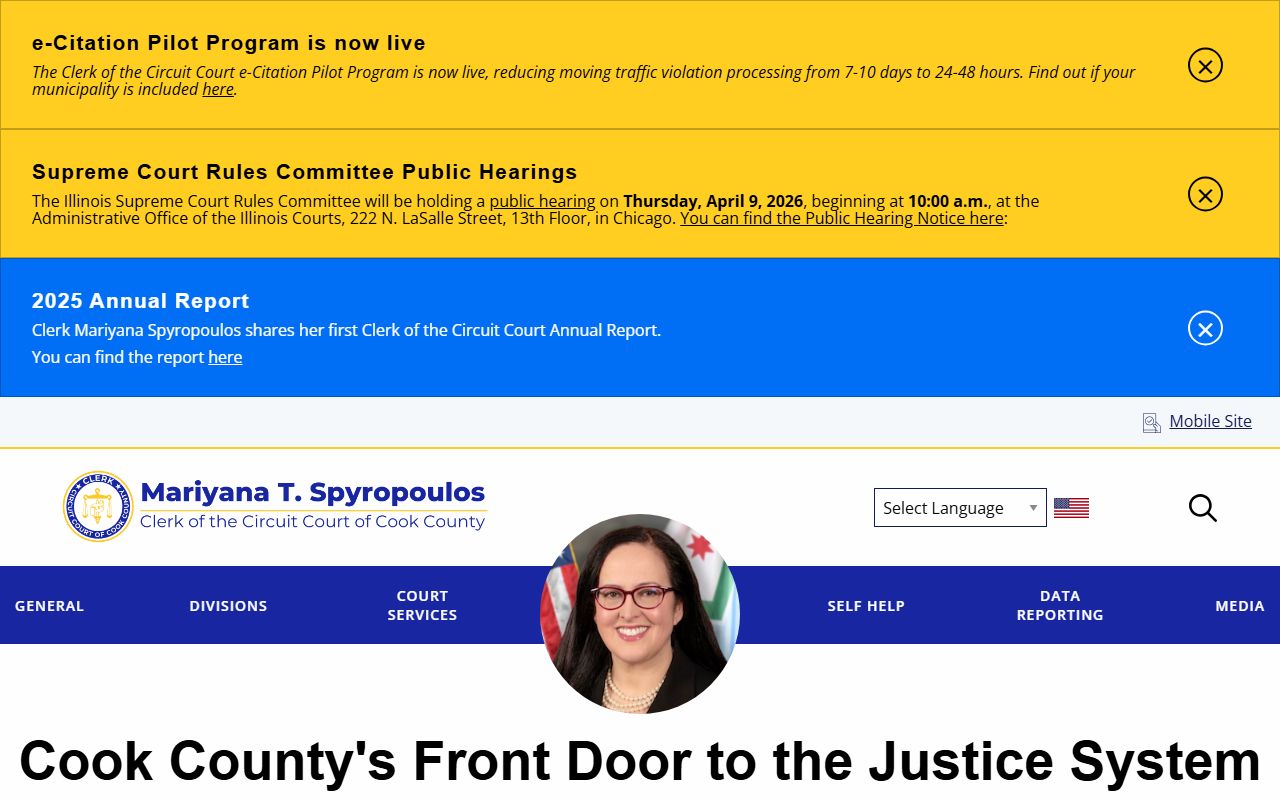
The Cook County Clerk of Court handles all Orland Park dissolution of marriage records, including final decrees and related court orders.
The site lets you look up cases by name or case number. You can see basic case info for free. To get a certified copy of a decree, you'll need to pay a fee and submit a formal request. Certified copies are often needed for name changes, property transfers, and other legal matters that come after a divorce is final.
Search Divorce Records Online
Two main tools let you search Cook County divorce records from home. The first is the Cook County Clerk of Court's own case search portal. The second is Judici.com, which covers more than 80 Illinois counties including Cook. Judici is free and does not require an account. You can search by party name and see basic case details, filing dates, and case numbers.
For cross-county searches, re:SearchIL gives access to case records across many Illinois circuit courts at once. This is helpful if you aren't sure which county a case was filed in. All three tools pull from public court data, so the same records are available through each one. Start with Judici if you want the quickest free search, then use the clerk's site if you need to order documents.
Keep in mind that very recent filings may take a few days to appear in online systems. If you need a record right away, call the Bridgeview Courthouse directly.
Illinois Law and Divorce Requirements
Illinois divorce law is governed by the Illinois Marriage and Dissolution of Marriage Act, 750 ILCS 5/. The state uses a no-fault system based on irreconcilable differences. You do not need to prove fault to get a divorce in Illinois.
To file in Illinois, at least one spouse must have lived in the state for 90 days before filing. If the spouses have lived apart for six months, that separation creates an irrebuttable presumption of irreconcilable differences. The six-month rule makes it easier to finalize a case without a contested hearing. Many Cook County cases settle without going to trial, especially when both sides agree on property and child custody from the start.
Court records in Illinois are public under 735 ILCS 5/. Most divorce decrees can be viewed by anyone. Some portions, like financial disclosure statements and minor children's information, may be sealed by court order.
Getting a Certified Copy of a Decree
Certified copies of divorce decrees are available from the Cook County Circuit Court Clerk. You can request one in person at the Bridgeview Courthouse or at the main downtown office. Mail requests are also accepted. The clerk's office will tell you the current fee when you call. Fees vary based on the number of pages and whether you need a raised seal.
If you need to verify a divorce happened but don't need the full court file, the Illinois Department of Public Health keeps a statewide dissolution of marriage index covering 1962 to the present. The IDPH does not provide full decrees, only verification letters. The fee is $5. You can mail a request to 925 E. Ridgely Ave., Springfield, IL 62702-2737, or call (217) 782-6554. Processing takes four to six weeks.
For full certified copies with all attachments and court orders, you must go through the circuit court clerk, not IDPH. The clerk's copy is what you'll need for most legal and financial purposes.
Free Forms and Legal Help
If you plan to file for divorce without an attorney, free standardized forms are available on the Illinois Courts forms page. These forms are approved for use statewide, including in Cook County. They cover the petition, financial affidavit, parenting plan, and final judgment forms.
Attorneys who file in Cook County must use the statewide eFileIL electronic filing system. This has been mandatory since July 1, 2018. If you are representing yourself, you may still be able to file paper documents in some situations. Check with the clerk's office first.
For free legal guidance, Illinois Legal Aid Online provides plain-language explanations of Illinois divorce law, step-by-step instructions, and help finding local legal aid organizations. Cook County also has a Family Law Self-Help Center at the Daley Center that can answer procedural questions.
E-Filing and Case Access
Cook County uses the eFileIL system for all attorney-filed cases. Once a case is filed electronically, it moves into the court's case management system and typically becomes searchable online within a few business days. Self-represented filers should ask the clerk how their documents will be processed and when records will be visible online.
If you already have a case number, you can use it to pull up the full docket through the Cook County clerk's site or Judici. The docket shows every document filed, every hearing date, and the current case status. You can see whether a final decree has been entered without having to call the courthouse.
Nearby Cities
Other Cook County cities near Orland Park also file divorce records through the Circuit Court of Cook County.
Cook County Court Records
All Orland Park divorce filings are part of the Cook County court system. Visit the county page for more details on clerk offices, courthouses, and search tools.