
Cook County Divorce Decree Records
Cook County divorce decree records are maintained by the Clerk of the Circuit Court of Cook County, one of the largest unified court systems in the world. With a population exceeding five million, Cook County handles an enormous volume of dissolution of marriage filings each year. This page explains how to search for Cook County divorce decree cases online, request certified copies, file electronically, use the Joint Simplified Dissolution process, verify records through the Illinois Department of Public Health, and find free legal aid and court forms for anyone dealing with a divorce in Cook County.
Cook County Quick Facts
Cook County Clerk of the Circuit Court
Mariyana T. Spyropoulos is the Clerk of the Circuit Court of Cook County. The clerk's main office for domestic relations, including divorce decree records, is located at the Richard J. Daley Center, Room 802, 50 West Washington Street in Chicago. This is the primary filing location for Cook County divorce cases. The office is open Monday through Friday from 8:30 a.m. to 4:30 p.m.
| Office | Clerk of the Circuit Court of Cook County |
|---|---|
| Clerk | Mariyana T. Spyropoulos |
| Mailing Address | 50 W. Washington, Suite 1001, Chicago, IL 60602-1305 |
| Filing Location | Richard J. Daley Center, Room 802, 50 W. Washington St., Chicago, IL 60602 |
| Phone | (312) 603-5030 |
| Fax | (312) 603-4557 |
| Hours | Monday through Friday, 8:30 a.m. to 4:30 p.m. |
Cook County also has district courthouses throughout the county and suburbs, including locations in Bridgeview, Markham, Skokie, Rolling Meadows, Maywood, and elsewhere. Some domestic relations filings may be heard at district locations. The main filing location for dissolution of marriage cases is Room 802 at the Daley Center.
The Cook County website has general county information, and the Clerk of the Circuit Court website has specific information about court filings and records.
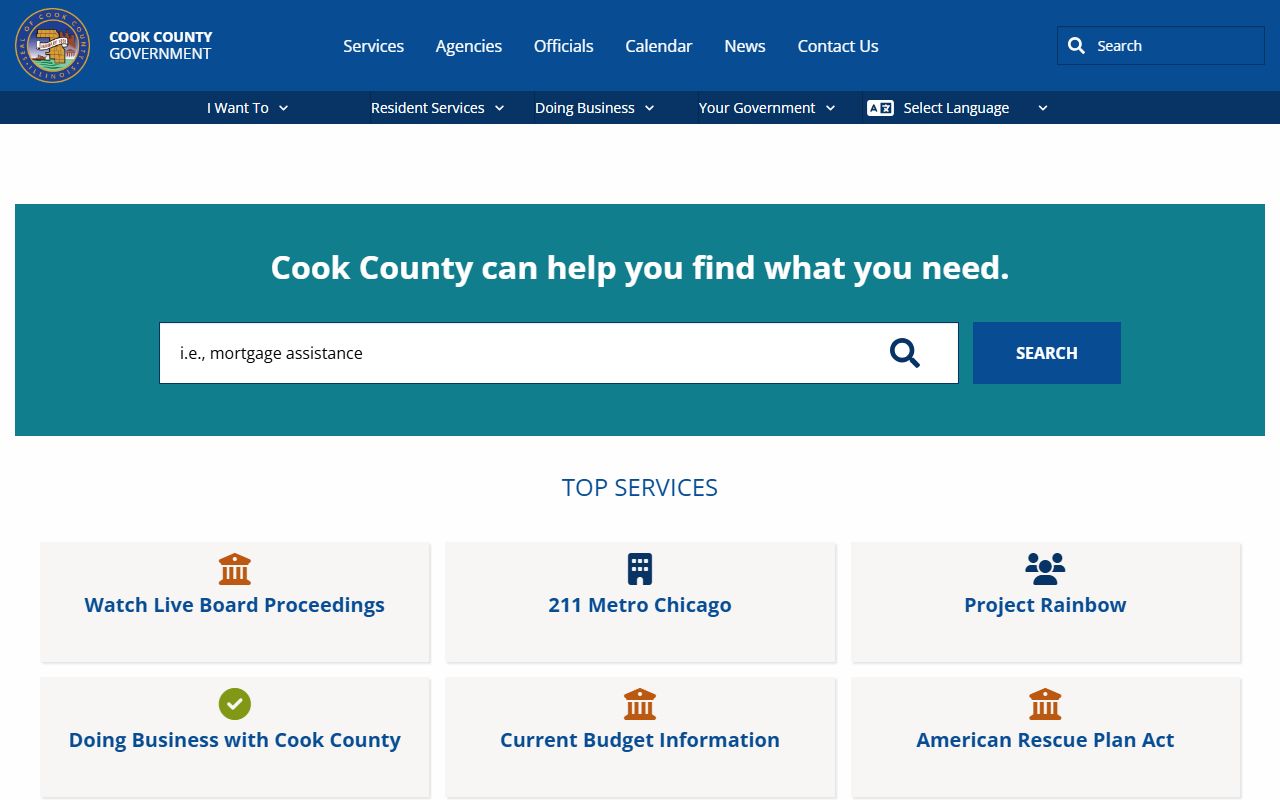
The Cook County official website, shown above, provides access to county services and links to the Clerk of the Circuit Court where divorce decree records are maintained for Cook County.
Online Case Search for Cook County Divorce Decrees
The Cook County Clerk of the Circuit Court provides an online case search portal at cookcountyclerkofcourt.org. You can search divorce and dissolution of marriage cases by party name or case number. This is the primary online tool for Cook County records and is separate from the Judici.com system used by many downstate Illinois counties.
The search is free and does not require an account. Results include case type, filing date, and a summary of court events. For older records or cases that may not appear online, in-person searches at the Daley Center in Room 802 are available during regular business hours. Staff can assist with name searches for historical records. Bring as much identifying information as you can: full names of both parties, approximate year, and any prior case number you may have.
The re:SearchIL system can also search Cook County records alongside other Illinois counties. This is helpful for cases where it is unclear whether the filing was in Cook County or a neighboring county like DuPage or Lake.
Cook County Divorce Decree Certified Copies
Certified copies of Cook County divorce decrees carry the official court seal and the clerk's signature. They are required for legal transactions: name changes with the Social Security Administration, passport applications, property title transfers, and immigration filings. Plain photocopies will not work for those uses.
To request a certified copy in person, visit Room 802 at the Richard J. Daley Center, 50 West Washington Street in Chicago, during business hours. Bring a valid government-issued photo ID and the full names of both parties. If you have the case number, bring it to speed up the process. Fees depend on page count and whether you need certification; call (312) 603-5030 to confirm current rates before your visit.
Mail requests are also processed. Send a written request with the full names of both parties, the approximate year of the divorce or the case number, your mailing address, and a copy of your ID. Include a check or money order payable to the Clerk of the Circuit Court of Cook County and a self-addressed stamped envelope. Mail processing typically takes one to three weeks, though volume at Cook County can sometimes mean longer wait times. Note: call to confirm current fees before mailing payment.
The Cook County e-filing portal is the primary online filing resource for Cook County, and the clerk's site also has information about requesting copies of documents from existing cases.
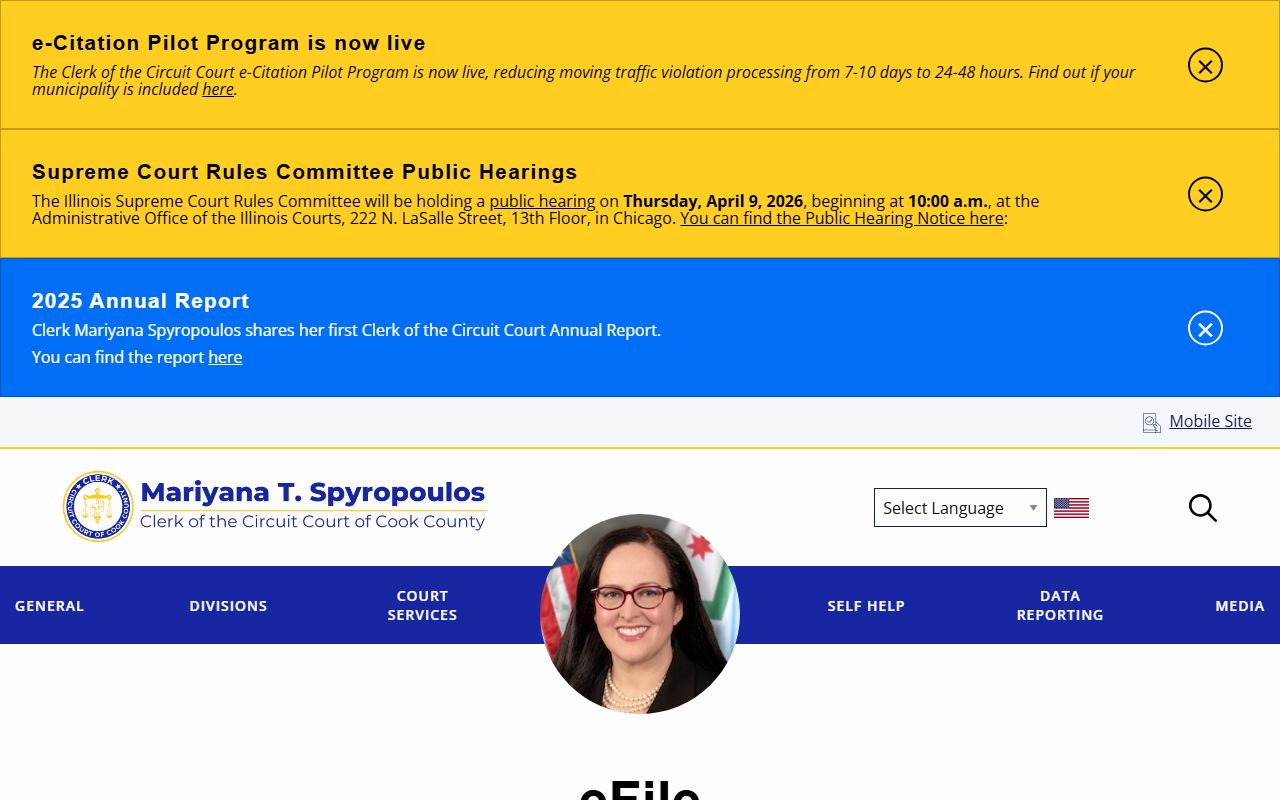
The Cook County Clerk of the Circuit Court e-filing portal, shown above, is used for electronic submissions and is also the starting point for online case searches and records requests in Cook County.
E-Filing Cook County Divorce Cases
Electronic filing is mandatory for all attorneys in Cook County and has been since July 1, 2018. Filings go through eFileIL, the statewide e-filing platform operated by the Illinois Courts. Self-represented parties may also file electronically through eFileIL or through the Cook County clerk's own e-filing system. Multiple approved e-filing service providers are available, and you can choose any one that is registered with the system.
Electronic filing does not replace in-person visits for things like certified copy requests, paying fees at the window, or appearing at hearings. But it substantially reduces paperwork and creates a clear record of when documents were submitted. For first-time filers, the clerk's office at (312) 603-5030 can help you understand which platform to use and how to submit documents correctly.
Paper filings are still accepted in limited circumstances, such as for self-represented parties who lack access to e-filing tools. Check with the clerk's office to confirm when paper filing is permitted for your specific situation.
Cook County Joint Simplified Dissolution of Marriage
Cook County offers a Joint Simplified Dissolution of Marriage process for couples who qualify. Both parties must appear in person together at the Daley Center, Room 802. When both spouses are present at the same time and all requirements are met, the hearing can often be completed the same day. This process is significantly faster than a standard contested dissolution.
To qualify, the marriage must be relatively short (under eight years in most cases), there must be no children born of or adopted during the marriage, neither spouse can be pregnant, neither party can have significant assets or retirement accounts in their name, and income must be below a certain threshold. Both parties must agree on all issues before appearing. Details on eligibility requirements and what to bring are available on the Cook County Joint Simplified Dissolution page. Payment at the courthouse is accepted by cash or money order only -- no personal checks.
The Cook County Clerk of the Circuit Court outlines the step-by-step process for Joint Simplified Dissolution, including the forms needed and how the hearing works.
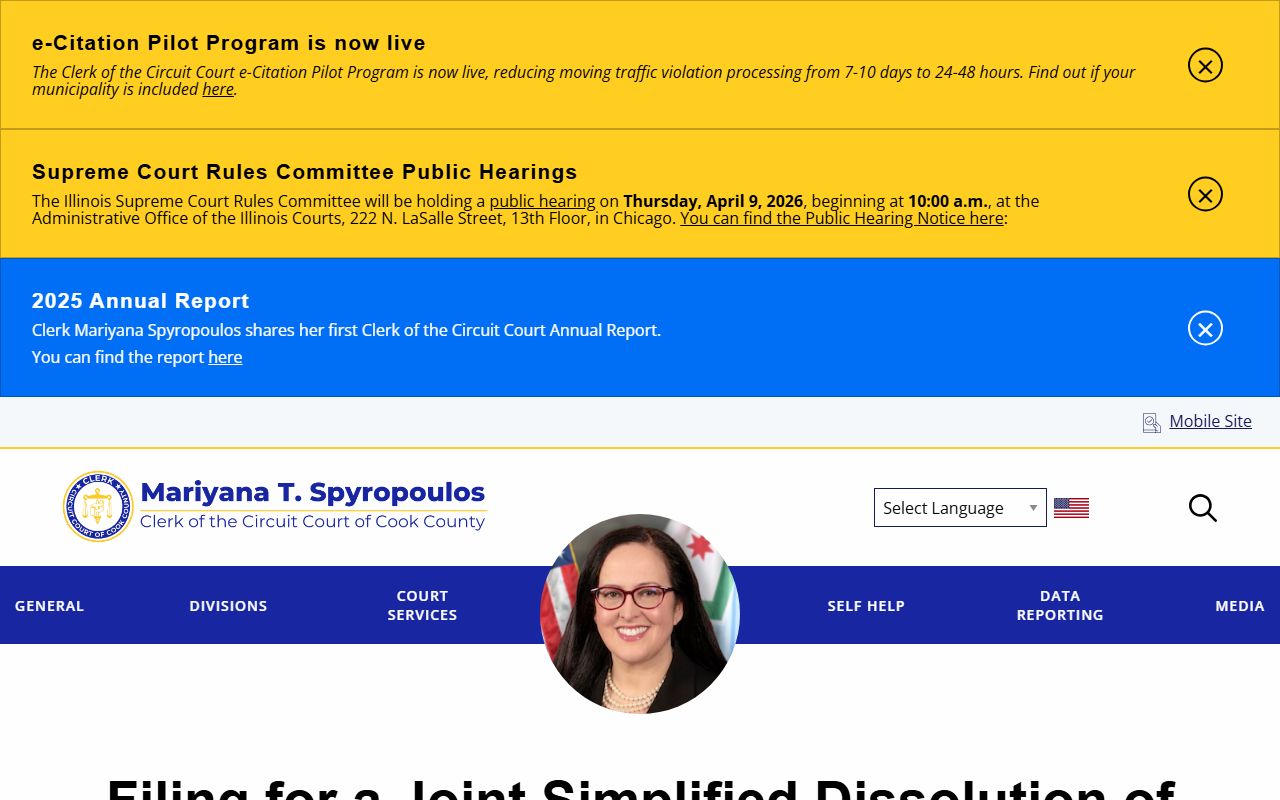
The Cook County Clerk of the Circuit Court's Joint Simplified Dissolution page, shown above, explains the same-day hearing process available for qualifying couples who want a fast, uncontested divorce in Cook County.
IDPH Verification for Cook County Divorce Records
The Illinois Department of Public Health maintains a statewide divorce index from 1962 to the present, including Cook County divorces. For $5, IDPH will verify that a divorce occurred and confirm names and county of filing. This is a verification only, not a certified court copy. For a certified copy of a Cook County divorce decree, you must contact the Clerk of the Circuit Court directly.
Mail IDPH requests to 925 E. Ridgely Ave., Springfield, IL 62702-2737. Phone: (217) 782-6554. Processing takes four to six weeks by mail. Given that Cook County processes the highest volume of divorce cases in Illinois, the clerk's own records are the fastest and most direct route for certified copies. IDPH is most useful when you need basic confirmation of facts without waiting for the clerk's processing time.
Illinois Divorce Law in Cook County
Cook County divorce cases are governed by the same Illinois law as every other county: the Illinois Marriage and Dissolution of Marriage Act (750 ILCS 5/). Illinois is a no-fault state. The only ground for divorce is irreconcilable differences. Under Section 401(a)(2), a six-month separation is conclusive proof of irreconcilable differences. The 90-day Illinois residency requirement applies before any filing. Under Section 104, Cook County residents file locally, but cases can also be filed here if either spouse lives in the county.
All Cook County divorce records are public under 735 ILCS 5/. Individual parts of a case file may be sealed by court order, but divorce decrees are generally accessible. The Vital Records Act (410 ILCS 535/) governs how IDPH tracks and indexes Cook County divorce records statewide.
Legal Aid and Divorce Forms in Cook County
Standardized divorce forms approved by the Illinois Supreme Court are available at no cost from the Illinois Courts forms page. These work in Cook County as in all other Illinois circuits. The forms include petitions, financial affidavits, and judgment templates used in both contested and uncontested cases.
Illinois Legal Aid Online provides free, plain-language guidance on divorce procedures in Cook County. The site covers filing, service, temporary orders, contested hearings, and final judgment. Cook County has several active legal aid organizations serving low-income residents, and Illinois Legal Aid's directory can help you identify the right one for your situation. The clerk's office at the Daley Center also has a self-help center with resources for unrepresented parties.
Cities in Cook County
Cook County is home to Chicago and many large suburban cities. All of the cities listed below have their own pages with city-specific divorce decree information and details on filing in Cook County courts.
Nearby Counties
Illinois law lets you file for divorce in any county where either spouse resides. If you have questions about whether to file in Cook County or a neighboring county, check these adjacent jurisdictions.